

Sam Altman famously has a betting pool with other tech CEOs on the year the first one-person billion-dollar company appears. Since then, the internet has filled up with predictions about AI agents replacing teams — lists of tools, hypothetical org charts, breathless math about what's possible.
Almost none of it comes with receipts.
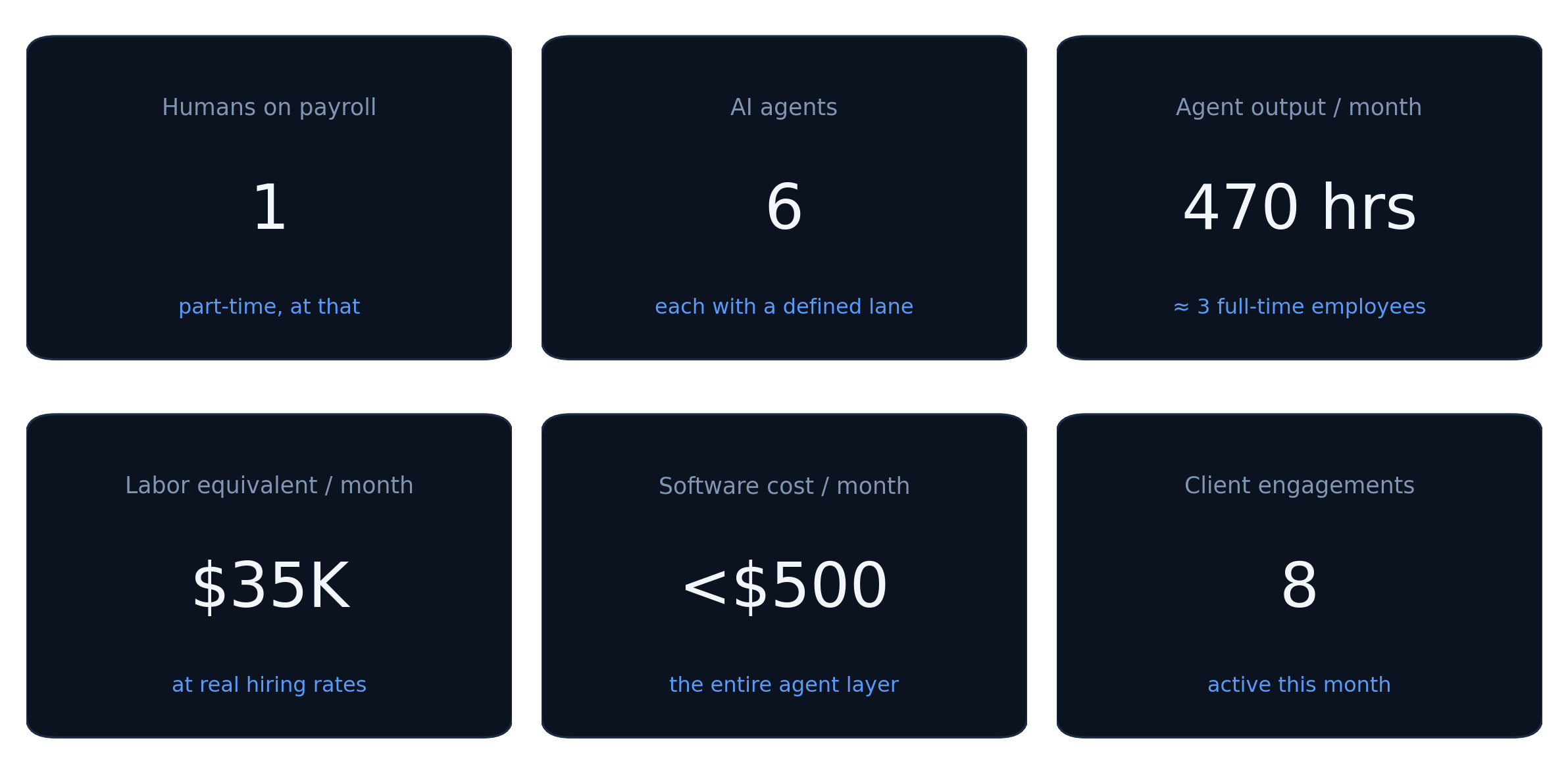
So here are mine. I run a RevOps consultancy. Last month it delivered across eight client engagements — CRM architecture, fit-scoring models built against live data, multi-scenario cost models, pricing structures, investor-ready analysis, and finalist presentations against firms quoting six-figure annual support contracts.
Headcount: one. And not even a full-time one — BrightReach runs in the hours around a full-time job.
This isn't a hustle story. That math doesn't work at any number of hours. It works because most of the labor in this business is no longer performed by a human. What follows is the actual 30-day ledger.
The org chart
Humans: 1. Me — strategy, client relationships, judgment calls, and final approval on anything that touches a client or a system of record.
AI agents: 6, each with a defined lane. A senior delivery agent handles client builds, data models, decks, financial analysis, and architecture. Carlee — the scoped ClickUp agent I wrote about building instead of hiring — runs operations coordination: tasks, project structure, follow-ups, the connective tissue. Four specialists cover time tracking, auditing, release documentation, and research.
Their assigned tasks are simple and complex. Sometimes it's just giving me a daily standup with all the tasks I need to complete and prioritizing them. One agent is completely responsible for going through all of my meetings and making sure I have meeting notes and follow-ups. Another makes sure my time is logged properly for billable hours. Every agent has a written scope, a defined write surface, and rules for what it may do without me. That governance layer matters more than the agents themselves — more below.
The 30-day numbers
My project management platform benchmarks agent output automatically: every action gets counted and priced at what a human would have taken to do it — four minutes per task update, six per document, sixty per artifact, and so on — valued at a $50/hour replacement rate for operational labor.
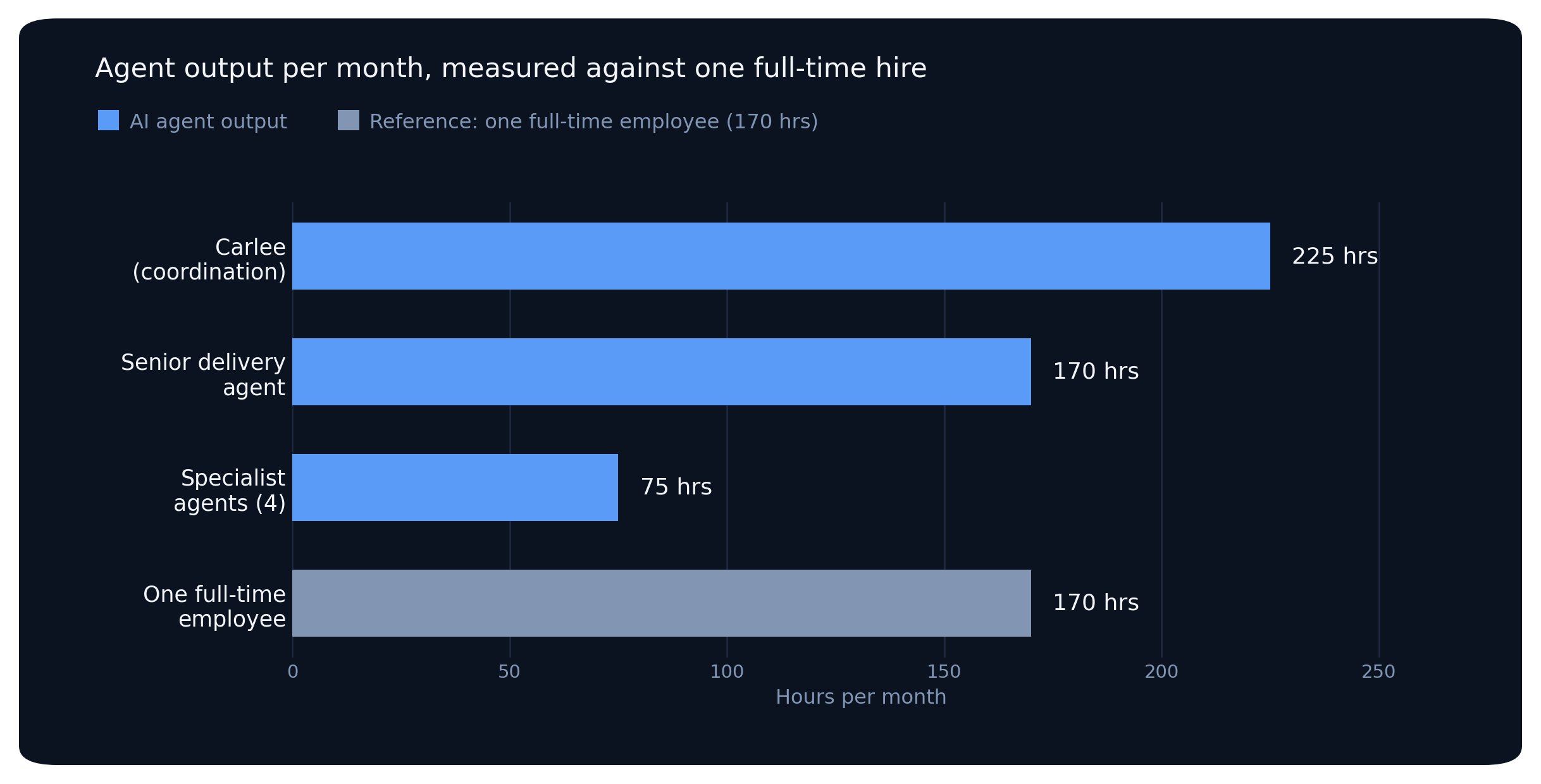 For the delivery agent — whose work doesn't get auto-counted the same way — I measured twice, independently. Method one: session-by-session time logs from our work journal. Method two: running its output through the same per-action benchmark table the platform uses. The two methods landed within 10% of each other (~165 vs ~177 hours). When two independent methodologies agree, you can trust the number. If anything it's understated: the benchmark prices every artifact at 60 minutes of human time, and nobody builds a 17-slide finalist deck or a five-year scenario cost model in an hour.
A full-time employee works about 170 hours a month. The agent layer is producing roughly 2.5–3 FTEs of output.
Priced honestly — $50/hr for the operational work, $125/hr for the senior delivery work (the rate I'd actually pay a human consultant to produce it, because I've priced that labor for real engagements) — the layer generates about $35,000 a month in labor equivalent. Total software cost: a few hundred dollars. That's not an efficiency gain. It's a different business model.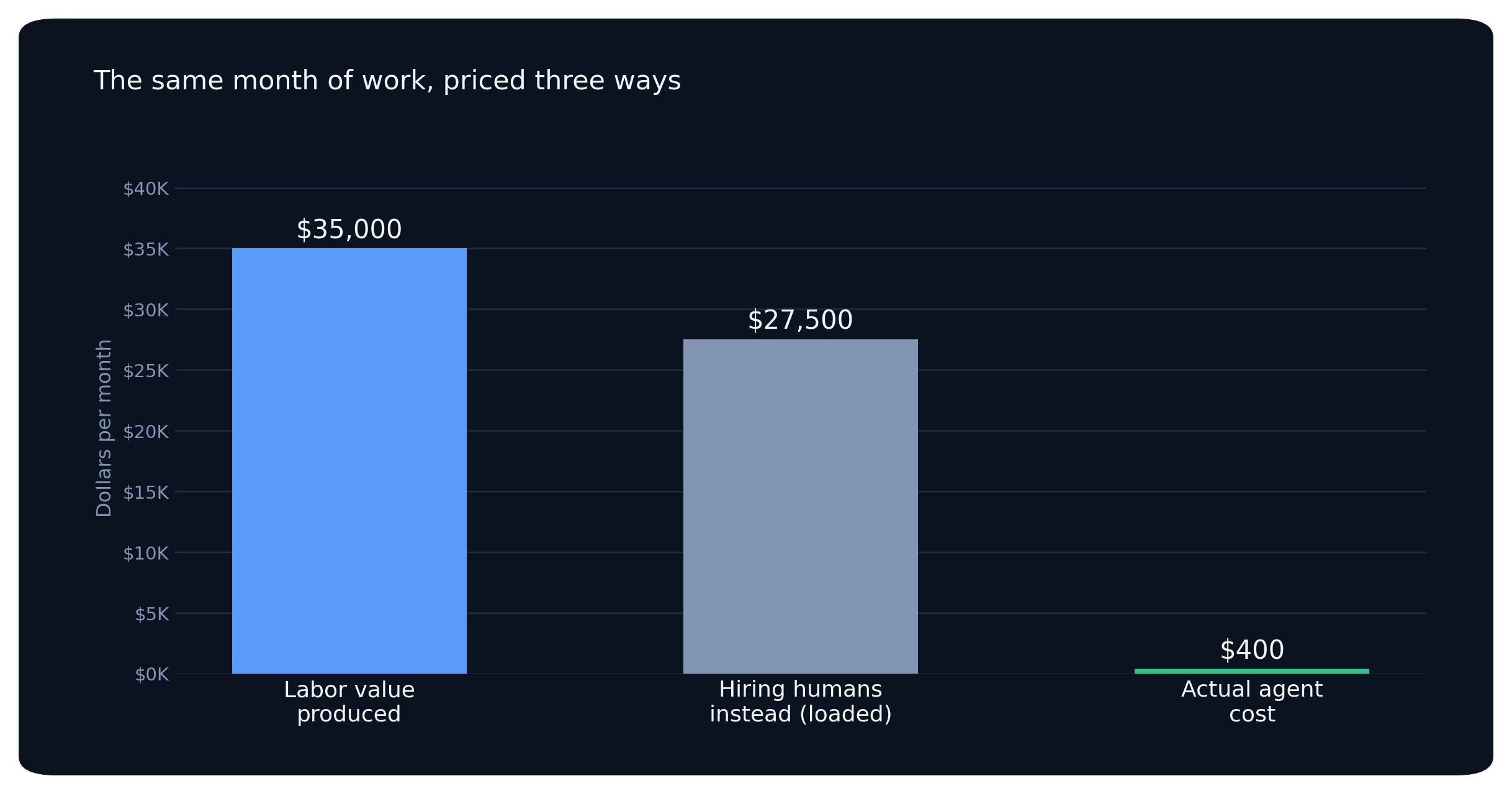
And hourly rates actually understate the replacement cost. Rates are what an hour of labor bills at; hiring is what labor costs. An employee runs 1.25–1.4x their wage once payroll taxes, benefits, PTO, equipment, and software seats load on. Rebuilding this layer with people means roughly a full-time operations coordinator, a fractional senior consultant at 100+ hours a month — a role I've written the hiring brief for and know how hard it is to fill — and admin coverage: call it $25–30K a month, loaded, before a single mis-hire. Then add the overhead nobody prices in: recruiting, onboarding, reviewing, and managing three people eats 10–20% of a founder's time per head. For someone running this firm around a full-time job, that's the real punchline — the human version of this org chart doesn't just cost more. At my hour budget, it was never buildable at all. The choice was never agents versus staff. It was agents versus a much smaller business.
What "senior delivery" means now
The comfortable assumption is that AI does the low-value work while the human does the real thing. That was true two years ago.
In the last 30 days, the delivery agent built a four-scenario platform cost model over a five-year horizon, rebuilt a company fit-scoring model against a live CRM, produced a productized service catalog with per-phase margin analysis, and turned a 10,000-record export into investor-facing market analysis. This is the work that used to require the senior consultant — because it did. I reviewed it, corrected it, and made the judgment calls. I didn't produce it.
The one-person firm's ceiling has always been the founder's hours. That ceiling just moved.
The unglamorous part: the system is the product
Buying AI subscriptions gets you none of this. Version one of my setup was agents stepping on each other, knowledge trapped in silos, and me re-explaining context to every session like it was a new hire's first morning.
What made it work:
- A shared knowledge vault. One version-controlled repository holding what's true about every client, every decision, every constraint. Every agent reads from it. Writes follow rules.
- One writer per surface. Agents never share a write surface. Two agents editing the same record is how you get confidently wrong data.
- Approval gates. Nothing client-facing and nothing irreversible ships without a human look. Agents propose; I dispose.
- A work journal. Every session logs what it did, decided, and how long it took.
And an honest confession: that last one was my weakest link. The agents my platform measures automatically looked great on the leaderboard, while the agent doing the highest-value work was invisible — because its logging depended on discipline instead of instrumentation. The delivery numbers above are conservative for exactly that reason. What gets measured automatically gets credited; measurement is a design decision, not an afterthought.
Why this matters beyond me
I'm the test lab. This operating model — software does the labor, humans do the judgment — is the same one I build for clients.
For agencies and consultancies, the uncomfortable version: your competition is no longer bounded by headcount. A one-person shop with a real agent architecture now carries a small team's delivery capacity at a cost structure no traditional firm can match. In two years this won't be a novelty; it'll be table stakes.
For small business owners, the comfortable version: you probably don't need the next hire yet. You need the system.
The billion-dollar one-person company makes a great betting pool. But you do not have to wait for that headline to see the model working. The three-FTE one-person company is already here. It is ordinary, and I can show you the ledger.
And even that understates the case. Those numbers do not price in hiring, adoption, management overhead, or the drag of carrying people who do not execute well or align with the work.
An AI employee does not need two months of ramp time. It does not vanish for a 2.5-hour lunch without warning. More importantly, once the surrounding system is sound, its output compounds. My working estimate is that the business is operating closer to the throughput of a six-FTE organization — and I will keep tracking the numbers as the ledger grows.
Want to know what an agent layer would produce inside your business? Start with a free Systems Review.